

The business case for safety training: why measurable impact matters more than completion rates
Most manufacturers have two training problems, not one.
The first is completion. Getting workers to finish required training consistently is harder than it sounds. High turnover, shift scheduling, training that isn’t available in the right languages or formats for the workforce, and generic LMS platforms that weren’t built for the realities of manufacturing operations all keep completion rates chronically low. A facility at 16% isn’t just missing a metric. It’s missing the foundation.
The second problem is harder. Even when completion is strong, there’s no guarantee training is changing behavior on the floor. Workers can finish a course and fall back on old habits the same afternoon. Completion tells you the training happened. It doesn’t tell you it worked.
Solving only one isn’t enough.
Completion is a process metric. Outcomes are what matter.
When a safety training program gets evaluated, the first question is almost always the same: what’s our completion rate? It’s measurable, it’s reportable, and it satisfies auditors. But completion is a measure of whether something happened, not whether it worked. A facility can hit 95% completion and still see recordable injuries climb year over year. The training happened. The behavior didn’t change.
The metric that matters sits one step further down the chain: what did the training produce? Fewer incidents. Faster corrective action. Workers who follow safe procedures without being reminded. Getting there requires a training system that is built for how adults learn, delivered in multiple languages for a diverse workforce, and reinforced on the floor.
This isn’t an argument against tracking completion. It’s an argument for not stopping there.
The ROI question most buyers never ask
Safety training is typically treated as a cost. It has a budget line, a compliance obligation, and a completion target. What it rarely has is a return on investment calculation.
That’s not because the ROI isn’t there. It’s because most organizations aren’t connecting the training data to the operational data. Injury rates, workers’ compensation costs, lost time, investigation hours, retraining cycles: these are all measurable. And they all move when training works.
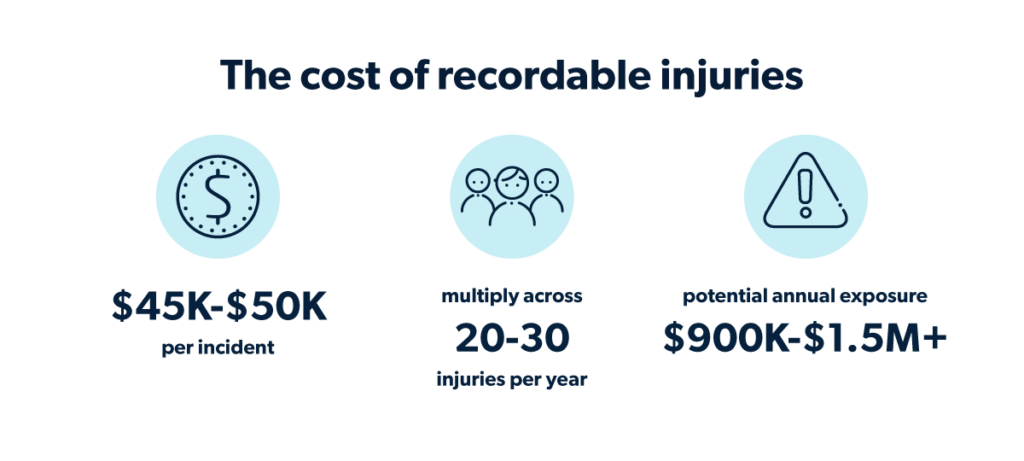
Each recordable injury in a food manufacturing environment carries a fully loaded cost of roughly $45,000 to $50,000 when direct and indirect expenses are counted. Workers’ compensation, lost time, investigation, and the slower, harder-to-measure drag on supervisory attention and morale. That number compounds quickly when you’re looking at a facility with 20 or 30 recordable injuries in a single year.
When training reduces incidents, it doesn’t just protect workers. It recovers dollars that were quietly leaving the business every time something went wrong.
What the data actually looks like
One of Intertek Alchemy’s industrial bakery clients came in with a training problem that will sound familiar to a lot of manufacturers. In 2022, training completion across the facility sat at just under 16%. That year, the facility recorded 29 OSHA recordable injuries.
Completion below 16% doesn’t just mean workers aren’t finishing courses. It means accountability gaps, inconsistent reinforcement across shifts, and a floor where the gap between documented procedures and actual behavior is wide enough for injuries to fall through.
They chose to close that gap. Not with a single initiative, not with an all-hands overhaul, but with consistent execution over time. With the Alchemy Training System in place, the facility had the infrastructure to assign training by role, track completion in real time, and hold the organization accountable to the numbers in a way their former paper-based processes couldn’t.
The results compounded year over year.
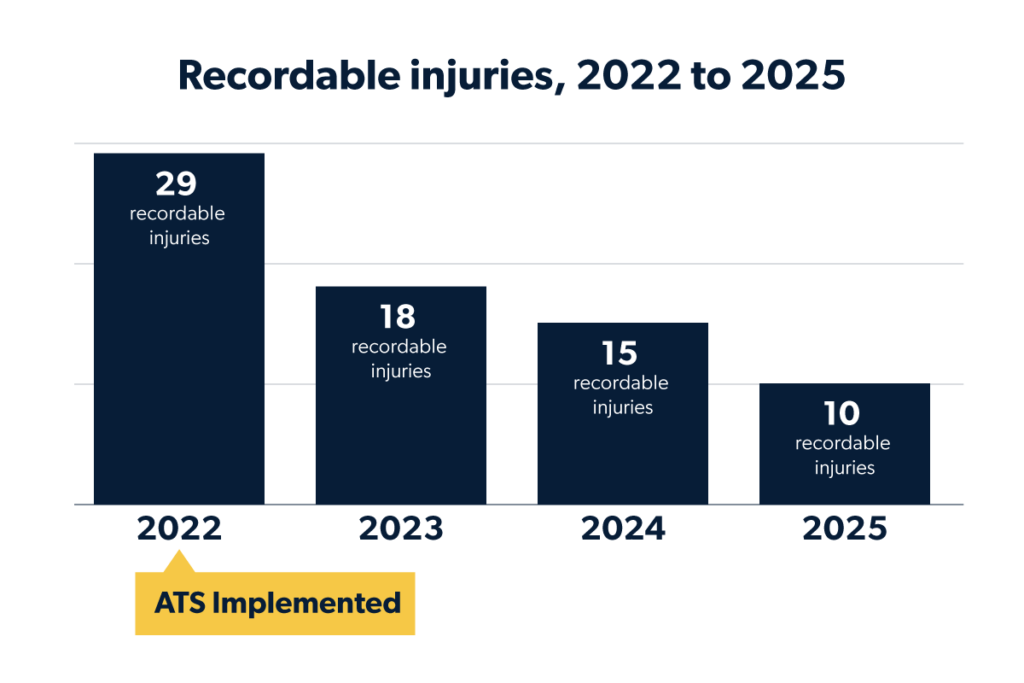
By 2025, completion had reached 88.49%. Recordable injuries had dropped by 65%, from 29 to 10. Each year improved on the last. No plateau, no regression.
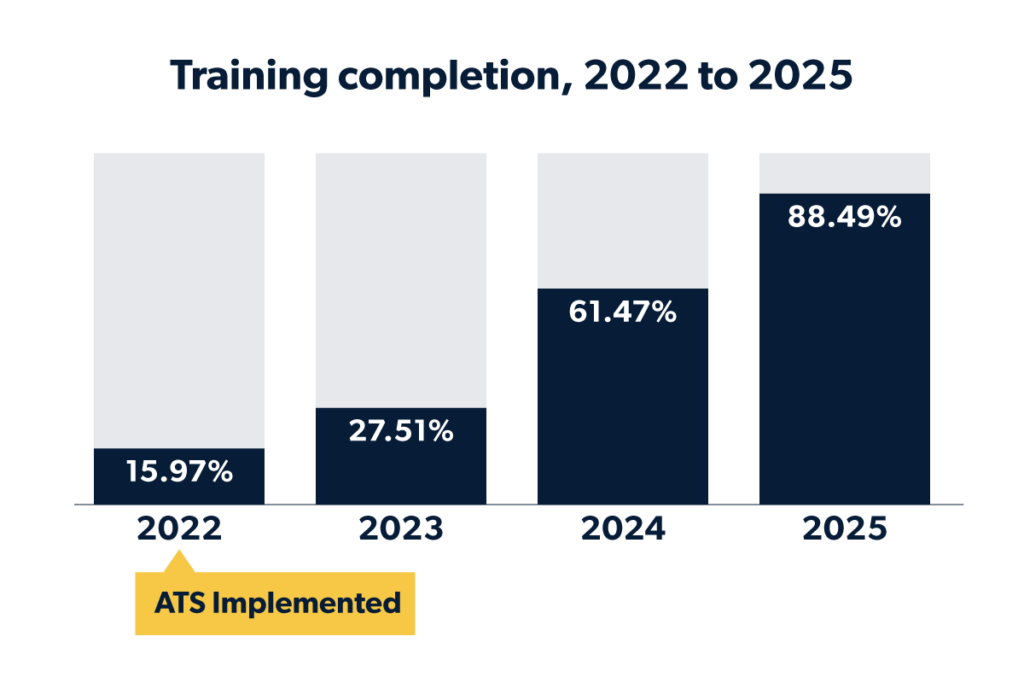
Using cost benchmarks specific to bakery operations, the estimated savings on those 19 fewer annual injuries lands between $850,000 and $900,000. Against their Intertek Alchemy investment, the return comes out to approximately 1,705%.
That’s not a completion rate. That’s a business result.
The difference between measuring training and managing it
The manufacturer in this story is not a global enterprise with unlimited resources. They’re an industrial operation with 180 employees, facing the same pressures most food manufacturers face: high turnover, shift-to-shift inconsistency, audit exposure, and a training function that has to justify its budget.
What changed wasn’t their workforce or their industry. What changed was their ability to manage training as an operational standard rather than a compliance checkbox. Real-time visibility into who had completed what. Role-based assignment that matched training to the actual job. Accountability that held across shifts, not just during audit prep. When training is managed that way, the outcomes follow.
What this means for your facility
If your facility is tracking injury trends, preparing for audits, or trying to move training completion off the floor of single digits, the question isn’t whether training has an ROI. The question is whether you know how to measure safety training effectiveness.
The manufacturers who treat training as an operational performance tool, not a compliance obligation, are the ones who end up with the data to prove its value. And when it comes time to justify the budget, defend the program, or make the case to leadership, proof is the only argument that holds.
The case study mentioned above shows exactly how they ran that calculation, and what four years of consistent execution produced. Read the full story here.
If you’re working to reduce injuries and build a workforce that doesn’t just complete training but applies it on the floor, this is what partnering with Intertek Alchemy makes possible. Their frontline performance system moves manufacturers from inconsistent completion to verified competency and gives them proof training is producing safer outcomes.
Frequently asked questions
Completion tells you a worker has finished a course. Effectiveness tells you whether it changed anything on the floor. A facility can have strong completion numbers and still see injury rates hold flat or climb because completing a course and applying what was learned are two different things. Effective training shows up in behavior, not just in a dashboard.
Start with your recordable injury count and the fully loaded cost per incident. In food manufacturing, that’s roughly $45,000 to $50,000 when direct and indirect expenses are counted. Multiply the number of injuries prevented by that cost to get your estimated savings. Divide by your total training investment and multiply by 100. The result is your ROI percentage. The math only works if you’re tracking both the training data and the injury data over time, which is where most facilities fall short.
Most operations underestimate it. The direct costs (workers’ compensation, medical expenses, lost time) are visible. The indirect costs are harder to see but add up quickly: investigation time, retraining, supervisory attention pulled from other work, and the drag on morale across a shift. When you count both, a single recordable injury in a food manufacturing environment typically runs $45,000 to $50,000. Multiply that across 20 or 30 injuries in a year and the number gets the attention of a CFO fast.
Longer than most expect, and that’s not a bad thing. The facilities that see the most significant outcomes are the ones that treat training as a multi-year operational commitment rather than a one-time initiative. In the case study referenced in this blog, year two showed meaningful but incremental progress. The compounding happened in years three and four. If your program is six months old and the injury trend hasn’t moved dramatically, that’s not a signal to stop—it’s a signal to stay consistent.
Connect the training data to the operational data and present them side by side. Show the completion trend alongside the injury trend over the same time period. Translate the reduction in incidents into dollars using a cost-per-injury benchmark specific to your industry. If your leadership team responds to financial proof points, a 1,705% ROI is a different conversation than “our completion rate went up.” The business case for safety training is strong, but it only holds up if you’re measuring the right things.